
Live-edge slab buyer guide
How to Choose a Live-Edge Slab
Start with the project and the space. A live-edge slab is chosen by matching its intended use, species, thickness, width, length, grain, and edge character to what you are building, then confirming moisture, movement, and any checks or cracks for that specific piece. Because wood gains and loses moisture with the humidity and temperature around it, a slab's moisture condition and the room it will live in matter as much as its size.
Use the sections below to decide what you actually need, then send those details when you ask about a slab. General wood behavior describes tendencies rather than a promise about one board, so the final step is always looking at the individual slab for the project.
By Yori, Fresno Forest Creations | Published | Updated and reviewed
Choose a slab in five steps
Work through these in order. The first three narrow the field to slabs worth considering. The last two are what you confirm on the actual piece and what you send when you ask.
Step 1
Start with the use and the space
Decide what the slab is for and where it will live before you compare pieces.
Step 2
Choose a species by look and behavior
Species differ in appearance, in how much they move, and in how prone they are to checking.
Step 3
Size it up
Thickness, width, length, grain, and natural edge set the scale and the character.
Step 4
Check the condition
Moisture, movement, checks, and acclimation are confirmed on the actual piece.
Step 5
Plan flattening and finish
Decide who flattens and finishes the slab, then send your details.
Step 1
Match the slab to how you will use it
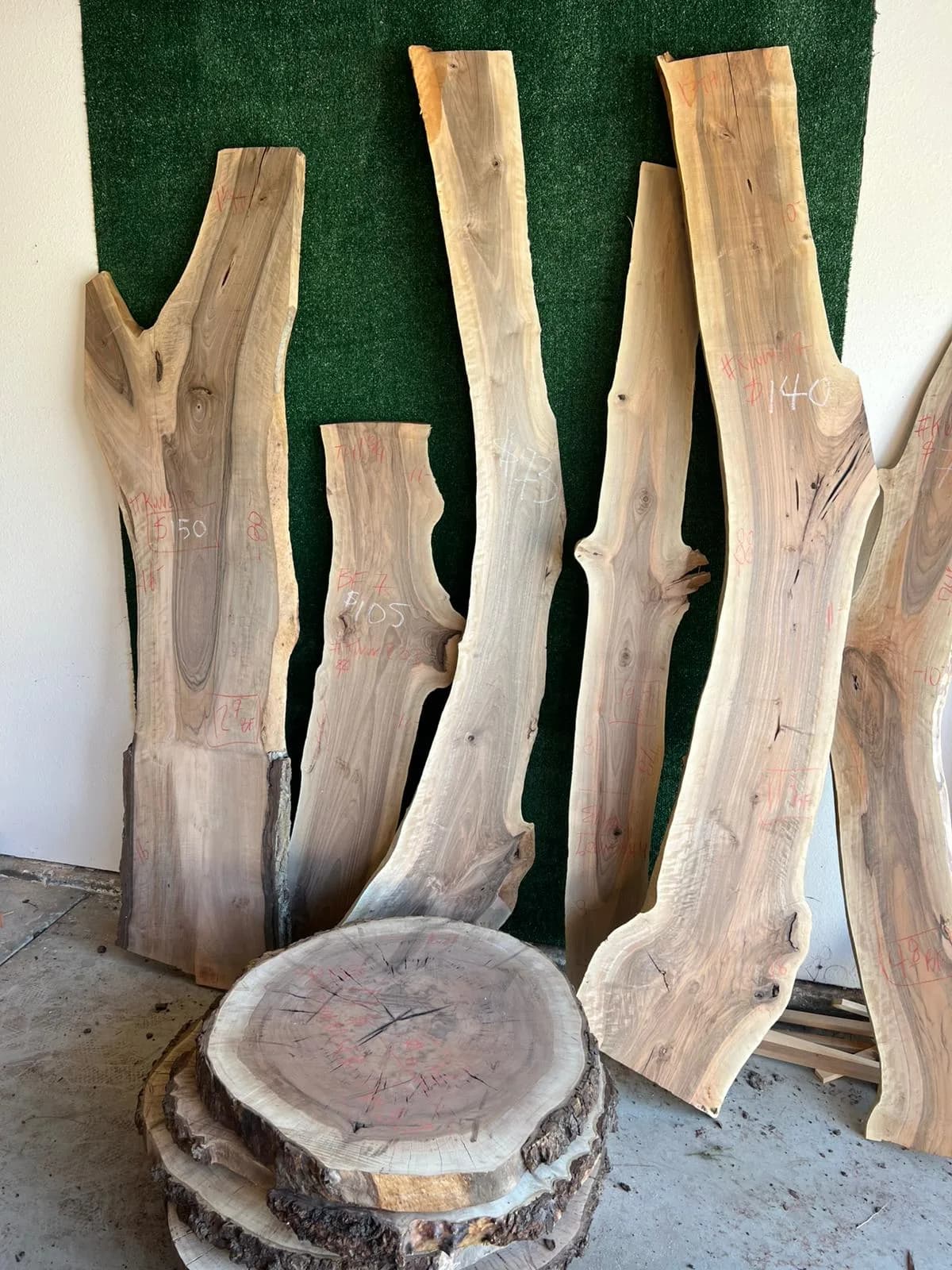
The intended use sets nearly everything else. A dining or conference table, a counter, a mantel, a bench, and a floating shelf each ask for different thickness, width, length, and edge character, and each lives in a different spot in the home. Decide what the slab is for and where it will sit before comparing individual pieces.
These are planning considerations, not a suitability rating. Anything that carries weight or attaches to a structure is a job for a qualified builder to size, and that engineering question is outside what this guide covers.
Step 2
Compare species by look, movement, and checking
Species differ in appearance, in how much they move as moisture changes, and in how prone they are to checking as they dry. Walnut, for example, moves more than old-growth redwood and western redcedar, so wider slabs of a higher-movement species can react more to seasonal humidity swings.
Species also differ in checking tendency. Redwood and cedar sit toward the lower-tendency end, walnut is intermediate, and the oaks are higher. Treat these as general tendencies to weigh alongside the look you want, not a prediction about a single slab.
| Species | Movement comparison | Checking tendency |
|---|---|---|
| Black walnut | More than the redwood and cedar listed here | Intermediate |
| Old-growth redwood | Less than black walnut | Lower |
| Western redcedar | Less than black walnut | Lower |
Compare color, grain, and edge on the actual pieces. These behavior tendencies are general, not a prediction about a single slab.
Black walnut
- Movement
- More than the redwood and cedar listed here
- Checking
- Intermediate
Old-growth redwood
- Movement
- Less than black walnut
- Checking
- Lower
Western redcedar
- Movement
- Less than black walnut
- Checking
- Lower
Step 3
Thickness, width, length, grain, and edge
Thickness, width, and length set the scale of the piece and the volume of wood. Thicker stock reads as more substantial, and it can also be more prone to surface and edge checking as it dries, because a thick piece dries unevenly between its surface and its interior.
Grain and the natural edge are where character lives. Look at grain direction and figure, and at how much natural edge, bark line, and void you want to keep or fill. When you want a rough volume estimate for a size you are considering, the board-foot calculator gives a quick figure to include with a request.
Step 4
Check the condition: moisture, movement, and checks
This is the part you confirm on the actual piece. The wood science below explains why moisture and cracks matter, so you know what to ask about.
Moisture and movement, and why they matter
Wood is dimensionally stable above the fiber saturation point, which averages about 30 percent moisture content. Below that point it shrinks as it loses moisture and swells as it gains moisture, and that shrinking and swelling is what can lead to warping, checking, and splitting.
Wood does not move evenly. It moves most across the growth rings, tangentially, about half as much across the rings radially, and only slightly along the grain. Tangential movement is roughly twice radial movement, which is why a wide slab reacts more across its width than along its length.
Equilibrium moisture content is the moisture content at which wood is neither gaining nor losing moisture, and it depends on the room. At about 70 degrees F and 30 to 50 percent relative humidity, indoor wood tends toward roughly 6 to 9 percent moisture content, per the Wood Handbook Table 4-2. That range describes general indoor behavior at those conditions. It is not a moisture level for any particular slab, and a finish slows moisture change without stopping it, so the slab's moisture condition still matters after finishing.
Checks, cracks, and acclimation
Surface checks are small splits along the grain that form when drying stresses exceed the wood's strength across the grain, as the surface dries much faster than the interior. End checks form because a slab dries much faster from its ends than from its faces, which is why ends are often coated during drying. Honeycomb is internal checking that can be invisible on the surface and only appear later when a slab is machined.
Because wood keeps exchanging moisture with its surroundings, the general aim is to bring a slab close to the moisture content it will reach where it will live, and to let it settle toward that environment before final work. Look a slab over for visible checks and cracks, and remember that internal checking may not show on the surface, so inspecting the individual piece is part of choosing it.
Step 5
Questions to ask about flattening and finish
A rough slab usually needs flattening before it becomes a finished surface, and it needs a finish suited to how the piece will be used. Decide who will flatten the slab and how it will be finished, and whether those steps are part of your plan or handled elsewhere.
Keep in mind that a finish slows moisture change but does not stop it, so the slab's moisture condition still matters after the piece is built. Ask these as questions up front rather than assuming a given outcome for a specific slab.
What to send for a live-edge slab quote
When you ask about a slab, describe the intended use, the species or look you want, and rough thickness, width, and length, along with how many pieces you need and the city for pickup or delivery. Photos or sketches of the project help the shop understand what you are after.
The live-edge slab page covers this quote guidance, and the quote-preparation guide walks through what makes any request complete. None of this confirms price or availability; it gives the shop enough to review the work and follow up.
Intended use and where it will live. What you are building and the room it will sit in.
Species or the look you want. Name a species, or describe the color, grain, and edge you have in mind.
Rough thickness, width, and length. Close is fine to start. The board-foot calculator turns these into a volume estimate.
How many pieces. One statement slab, a matched pair, or several.
Pickup or delivery city. Where the slab is headed, so the shop can plan handling.
Photos or sketches. Helpful whenever a picture explains the project better than words.
Live-edge slab selection checklist
Before you ask about a slab, run through a short checklist: the intended use and where the piece will live, the species or look you want, rough thickness, width, and length, the grain and edge character you prefer, the number of pieces, and the pickup or delivery city.
Moisture condition. Ask about the slab's moisture condition for the room it will live in.
Visible checks and cracks. Look over surface and end checks, and remember internal checking may not show.
Acclimation plan. How the slab will settle toward the space before final work.
Flattening and finish plan. Who will flatten the slab and how it will be finished.
Then plan the pieces you will confirm on the individual slab: its moisture condition, any visible checks or cracks, how it will settle toward the room it will live in, and who will flatten and finish it. Choosing a slab ends with looking at the actual piece, so treat this list as what to prepare and what to check, not a promise about any single board.
Ask about a live-edge slabOptional depth
Source-backed buyer guide
How this guide is supported
- Published
- Last updated
- Last reviewed
The wood-science parts of this guide are drawn from the USDA Forest Products Laboratory Wood Handbook and a Purdue University extension publication on checking, with exact chapters and tables noted. Quote inputs come from the published Fresno Forest Creations slab guidance. General wood behavior describes tendencies; the condition of any specific slab, and its price and availability, are confirmed only after the shop reviews the piece and your project.
Exact sources
- 1. Chapter 4: Moisture Relations and Physical Properties of Wood, Wood Handbook (FPL-GTR-282) by USDA Forest Service, Forest Products Laboratory, Tables 4-2 and 4-3; pages 4-1 to 4-8.
- 2. Quality Control in Lumber Purchasing: Surface, End, and Internal Checking (Honeycomb), FNR-133 by Purdue University Cooperative Extension Service, Table 1 and pages 1 to 4.
Where each part comes from
The wood-science claims above trace to the exact sources listed. Open a section to see which fact maps to which reference.
Overview
Compare species by look, movement, and checking
Thickness, width, length, grain, and edge
Moisture and movement, and why they matter
Checks, cracks, and acclimation
Questions to ask about flattening and finish
Related resource