
Kiln drying inquiry guide
Kiln Drying Wood: How It Works and What to Know
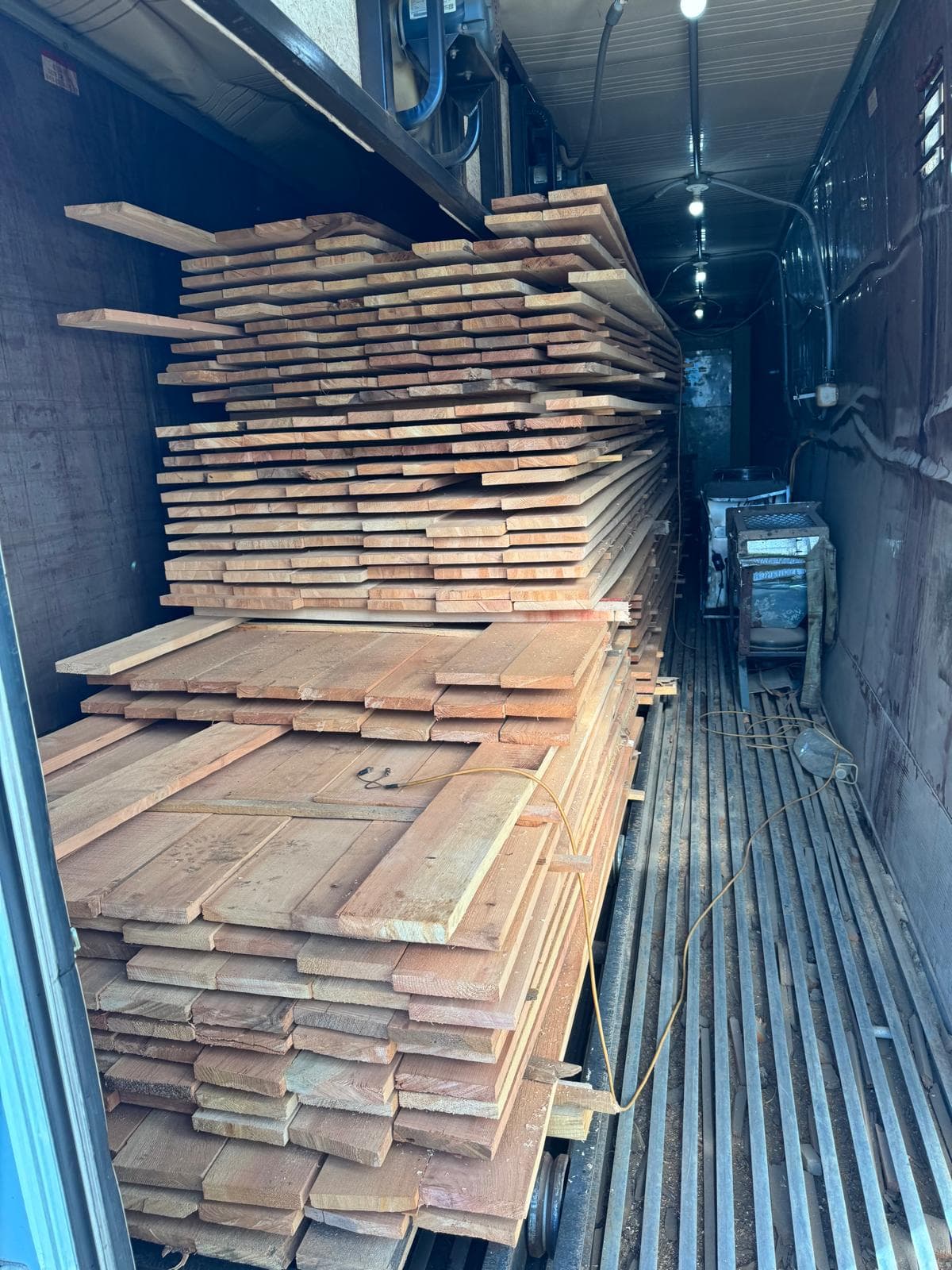
Kiln drying lowers the moisture content of wood in a controlled, insulated chamber, helping it reach lower moisture levels than air drying for uses that require drier material. It does not seal wood at one moisture level, because wood is hygroscopic and keeps taking on and giving off moisture with the air around it.
Start with the inquiry checklist and shop expectations below. The deeper wood science is available afterward if you want it. Intake, capacity, timing, and handling for your specific material are confirmed with the shop before scheduling.
By Yori, Fresno Forest Creations | Published | Updated and reviewed
What kiln drying does and does not do
Start here. Kiln drying is useful, but it is not a permanent fix or a promise of a flawless result. Knowing both sides keeps your expectations realistic.
What it does
Kiln drying removes free water and much of the bound water from wood. Drier wood weighs less, holds fasteners and glue better, takes finishes more evenly, and is less prone to staining, decay, and insect attack than green wood. As wood dries below the fiber saturation point, it also gains strength.
What it does not do
What kiln drying does not do is just as important. It does not lock moisture in place. Because wood keeps exchanging moisture with its surroundings, a dried piece can still move, check, or change dimension when the humidity around it swings. Drying lowers the risk of decay and insects, but it does not make wood immune to them forever, and it is not a promise that a piece will never move or crack.
Prepare your inquiry
Three steps to a useful inquiry
Step 1
See whether drying fits
Decide if your wood needs to be drier for what you are building. Kiln drying helps when air drying alone cannot reach the dryness your end use needs.
Step 2
Gather your wood's details
Note the species, rough size, quantity, approximate board feet, current moisture context, intended use, and timing.
Step 3
Ask the shop to review it
Send the details so Fresno Forest Creations can review the material. Sending them does not confirm capacity, timing, or acceptance.
What to include when you ask
A useful inquiry gives the shop enough to picture your wood. The checklist below covers what helps. None of it confirms a schedule, capacity, or acceptance. It gives Fresno Forest Creations enough to review the material and talk through next steps.
Species. The kind of wood, if you know it. This gives the shop a clearer picture of the material.
Rough thickness, width, and length. Approximate measurements of the pieces are enough to start the conversation.
Quantity and approximate board feet. How many pieces, plus a rough board-foot estimate. The calculator can work this out for you.
Current moisture context. Anything you know about the wood now, such as freshly cut, air dried for a while, or stored inside.
Intended use. What you are building and where the wood will live, since the useful dryness depends on the end use and the climate around it.
Timing. When you are hoping to use the wood, so the shop can talk through what is realistic.
Fresno Forest Creations reviews drying for customer-provided wood and for FFC material where available. You can estimate approximate board feet with the calculator before you ask, and the quote-preparation guide walks through what makes any request complete.
What to expect from Fresno Forest Creations
Kiln drying is not booked instantly online. Intake, capacity, timing, and handling are confirmed before scheduling, so the best next step is to confirm the species, dimensions, timing, and kiln capacity with the shop. Scheduling is confirmed before intake.
This guide describes general wood science, not this shop's specific kiln, its capacity, or a set schedule. Those details are confirmed with the shop when you ask about your material, and asking does not confirm timing, capacity, or acceptance.
Optional depth
The wood science behind drying
Open any section for the details. None of this changes the steps above. It explains why moisture, drying speed, and end use matter, so you know what to ask about.
Air drying compared with kiln drying
Air drying means stacking wood so air can pass through it and letting it dry over time. In most climates it typically brings wood only to around 20 to 30 percent moisture content and can take a year or more, so on its own it usually cannot reach the levels wanted for interior use.
Kiln drying uses an insulated, controlled chamber to remove free water and much of the bound water, reaching lower moisture contents than air drying and in less time. This describes kiln technology in general terms, not any one shop's specific equipment or process.
Moisture content and why there is no single target
Wood seeks an equilibrium moisture content set by the relative humidity and temperature around it, so the moisture level it settles at depends on where it lives. Above the fiber saturation point, about 25 to 30 percent moisture content, losing water does not change the wood's dimensions. Below that point, wood shrinks as it dries and swells as it gains moisture.
Because equilibrium moisture content depends on the environment, there is no single correct number for every project. Wood headed for a heated interior tends to stabilize near about 8 percent moisture content. Wood used outdoors but covered ranges from around 12 percent in humid regions down to about 6 percent in the arid Southwest. Wood in an occasionally heated interior space sits nearer about 18 percent. These are general ranges tied to end use and climate, not a target for any particular piece and not a statement of what any one shop dries to.
How moisture content is measured
Moisture content is expressed as the weight of water in the wood compared with the wood's dry weight, which is why it is given as a percentage rather than judged by feel.
The reference method is the oven-dry method. A sample is weighed, dried in a lab oven at about 103 degrees C until it reaches a constant weight, and weighed again. The moisture lost compared with the dry weight gives the moisture content. This is the benchmark the percentage figures above are based on.
Common drying defects and why they happen
Drying stresses can cause several defects, and drying too fast is a common cause. Surface checks are small splits along the grain that form when the surface dries much faster than the interior. End checks form because the ends of a board dry faster than its faces. Splits are larger separations that can run through a piece.
Warp covers several shape changes: bow along the length, crook along the edge, cup across the width, and twist. Casehardening is locked-in stress left when the outside and inside dry unevenly. Honeycomb is internal checking that may not show on the surface and can appear later when a piece is machined.
Where this comes from
Source-backed buyer guide
How this guide is supported
- Published
- Last updated
- Last reviewed
The wood-science sections of this guide come from a University of Kentucky Cooperative Extension publication on drying wood, with the pages noted. General wood behavior describes tendencies and environment-dependent ranges, not a target for any specific piece. What Fresno Forest Creations can dry, and the capacity, timing, and handling for your material, are confirmed only after the shop reviews your request.
Exact sources
- 1. Drying Wood, Publication FOR-55 by University of Kentucky Cooperative Extension Service, Pages 1, 2, 4, and 6.
Where each part comes from
The wood-science claims above trace to the exact source listed. Open a section to see which fact maps to the reference.
Overview
What kiln drying does and does not do
Air drying compared with kiln drying
Moisture content and why there is no single target
How moisture content is measured
Common drying defects and why they happen
Related resource