
From Green Lumber to Furniture-Grade Wood: What I Learned Working with Ryan Moore and Urban Wood Company
Working beside Ryan Moore and the Urban Wood Company team gave Yori a firsthand look at the labor, moisture control, and patience behind furniture-grade lumber.
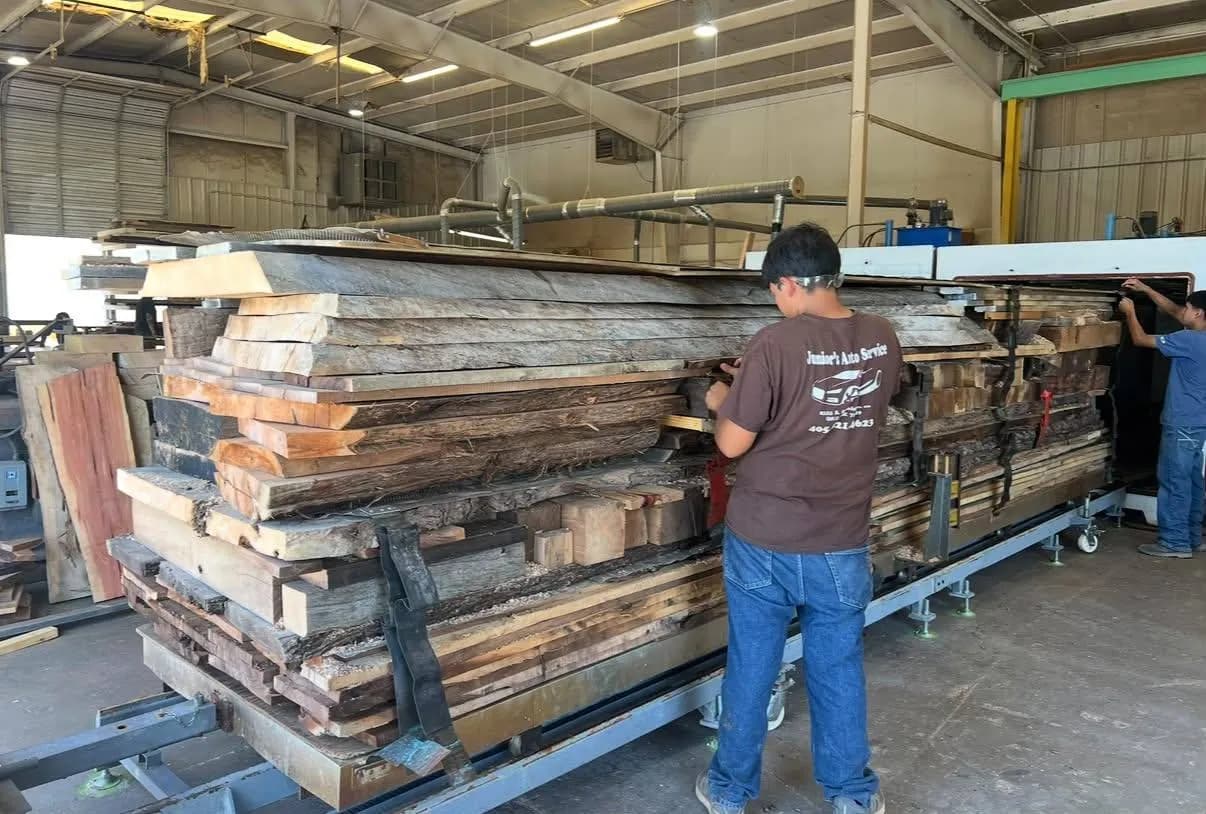
Working with Ryan Moore and the team at Urban Wood Company in Oklahoma City gave me a whole new appreciation for something most people never see when they look at a beautiful piece of finished lumber: the drying process.
People see a walnut slab, a table, a countertop, or a piece of furniture and notice the grain, color, and craftsmanship. What they don’t see are the hours of work that went into that wood before it was ever ready to build with.
And during the hot, humid Oklahoma summer, I learned firsthand just how much work that can be.
It Starts With Green Lumber
Freshly cut lumber contains a tremendous amount of moisture. We call this green lumber.
A tree may have been standing in the ground only weeks earlier, pulling water through its root system. Cutting that tree into boards doesn’t suddenly remove that moisture.
That water has to come out.
And it has to come out properly.
If green lumber is turned into furniture too soon, you’re asking for problems later. As the wood continues drying, it can shrink, twist, cup, bow, check, or crack. Joints can separate. Tabletops can move. Doors can warp.
You can build a beautiful piece of furniture from improperly dried lumber and have it look perfect when it leaves the shop.
Six months later, it may be a completely different story.
That’s why I learned to think of kiln drying as part of the craftsmanship—not simply a step that happens before the craftsmanship begins.
Working With Ryan Moore and Urban Wood Company
My experience working with Ryan Moore at Urban Wood Company in Oklahoma City helped me understand the drying process on a completely different level.
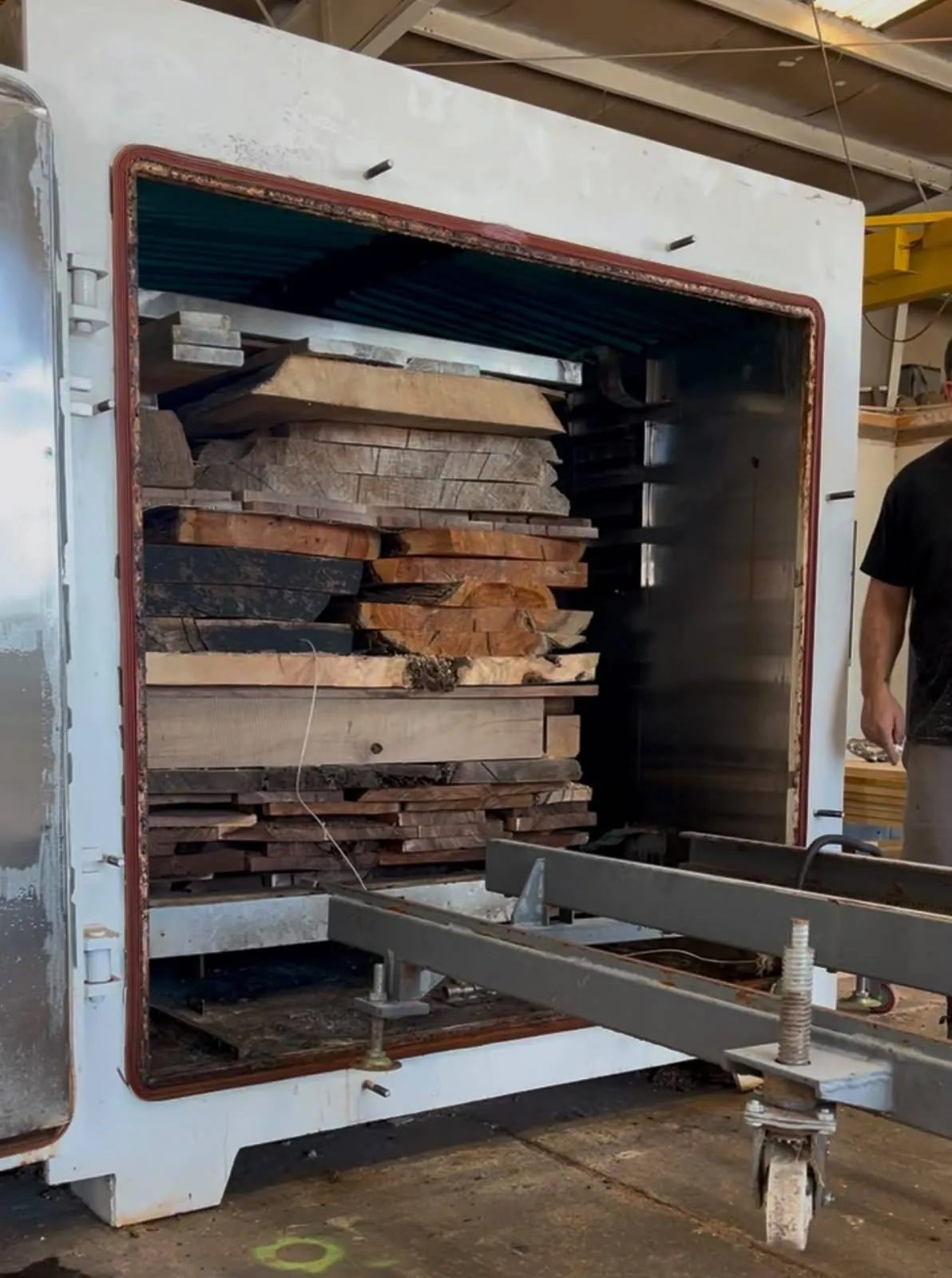
We were working with a radio-frequency kiln, or RF kiln.
Unlike a conventional kiln that primarily heats lumber from the outside using hot circulating air, radio-frequency drying uses electromagnetic energy to generate heat within the wood itself. This can make it possible to move moisture through thick hardwoods much more efficiently when the process is managed correctly.
That’s especially valuable when you’re dealing with beautiful hardwoods like black walnut.
But don’t let the technology fool you.
The machine may be sophisticated.
The lumber is still heavy.
Loading a Kiln in an Oklahoma Summer
This is the part customers don’t see.
Loading and unloading lumber into a kiln is physical work under any conditions. Doing it during an Oklahoma City summer is another experience altogether.
The heat is one thing.
The humidity is another.
You’re handling heavy pieces of lumber, organizing stacks, placing stickers between layers for proper spacing, keeping everything positioned correctly, and moving board after board.
And you’re sweating the entire time.
There were moments when I remember thinking, this is what it actually takes to produce properly dried lumber.
You don’t appreciate how heavy green wood is until you’ve spent time moving it.
Green lumber can contain an incredible amount of water, and you’re literally moving some of that water every time you pick up a board.
Then, after the drying cycle, you’ve got to do it again.
Unload the kiln.
Board after board.
Stack after stack.
In that Oklahoma heat.
It was exhausting, but it also gave me a tremendous respect for the process.
Why Can’t You Just Let Wood Dry Outside?
I get versions of this question all the time.
Why not just stack lumber outside and wait?
Air drying absolutely has a place in lumber production. In fact, hardwood lumber is often air-dried first before finishing the drying process in a kiln.
But air drying alone doesn’t necessarily bring lumber down to the moisture content required for stable interior furniture.
Wood naturally tries to reach what’s called its equilibrium moisture content. In simple terms, wood continually exchanges moisture with the air around it.
And that’s where Oklahoma humidity taught me an important lesson.
When the surrounding air contains a lot of moisture, lumber doesn’t simply keep getting drier forever because it’s sitting outside.
Eventually, the surrounding environment limits how dry that lumber can become.
A properly controlled kiln allows us to continue reducing moisture under controlled conditions.
Drying Wood Too Fast Can Be a Problem Too
There’s another side to this.
You can’t simply throw green lumber into extreme heat and assume hotter and faster is better.
Wood needs to dry in a controlled way.
If moisture leaves different areas of a board too quickly or unevenly, internal stresses can develop. Depending on the species, thickness, starting moisture and drying conditions, you can end up with checking, splitting, honeycombing, case hardening or other defects.
That’s why proper kiln drying is different from simply heating wood.
You’re managing moisture.
You’re managing temperature.
You’re managing time.
And you’re trying to protect a natural material that may have taken 50, 80, 100 years—or considerably longer—to grow.
Once I started looking at it that way, kiln drying became much more than a production step.
It’s preservation.
Why Moisture Content Matters
For furniture and other interior woodworking projects, the goal isn’t to make wood contain absolutely zero moisture.
That’s neither realistic nor desirable.
The goal is to bring the lumber into an appropriate moisture range for where it will ultimately be used and to make sure that moisture is reasonably consistent throughout the material.
That’s an important distinction.
A moisture meter reading on the surface doesn’t necessarily tell you everything happening deep inside a thick slab.
That’s one reason thick hardwood slabs require special attention.
The outside can feel dry while substantial moisture remains deeper inside.
Then somebody turns that slab into a $5,000 dining table.
The wood goes into an air-conditioned house.
And eventually that trapped moisture starts working its way out.
That’s when problems can appear.
Radio-Frequency Kiln Drying Changed How I Look at Lumber
Watching and participating in the RF kiln process at Urban Wood Company gave me a deeper understanding of what happens inside a piece of lumber.
With radio-frequency drying, energy penetrates the wood and generates heat internally, helping drive moisture outward. For thick hardwoods and slabs, that can be a major advantage when the drying schedule and equipment are properly managed.
There’s something fascinating about taking lumber that recently contained so much water and gradually turning it into stable material ready for woodworking.
But what I’ll remember just as much as the technology is the work.
Loading that lumber.
Stacking it.
Handling those heavy boards.
Sweating through an Oklahoma summer.
Waiting for the process.
And then coming back and unloading everything again.
It made me realize that when someone buys properly dried lumber, they’re not just paying for a piece of wood.
They’re paying for time, equipment, energy, knowledge, labor and risk.
Proper Drying Protects the Builder—and the Customer
At Fresno Forest Creations, this experience changed the way I think about the material we sell.
Beautiful grain gets people’s attention.
But proper moisture content is what helps that beautiful grain stay beautiful.
If I’m selling someone walnut for a dining table, redwood for furniture, or lumber for another woodworking project, I want that customer to understand what happened before that board reached them.
Because quality starts long before the first cut.
It starts with choosing good logs.
It continues through milling.
Then stacking.
Air drying when appropriate.
Kiln drying.
Checking moisture.
Surfacing.
And finally turning that lumber into something that may remain in a family for generations.
I Have a Different Respect for Kiln-Dried Lumber Now
I’ll never look at a stack of kiln-dried lumber quite the same way again.
When I see those boards, I remember Oklahoma City.
I remember Ryan Moore and Urban Wood Company.
I remember the RF kiln.
I remember the heat and humidity.
And I definitely remember how heavy those boards were going into that kiln—and what it took to get everything loaded and unloaded.
That experience taught me something important:
Great woodworking doesn’t begin when you turn on the saw.
It begins much earlier.
It begins with understanding the wood itself.
You can have the best tools, the best joinery and the best craftsman in the world, but if you start with improperly dried lumber, you’re building problems into the project from day one.
That’s why I’m such a believer in properly drying green lumber before using it.
You can’t rush nature. But with the right knowledge, equipment and patience, you can work with it.
Related resource